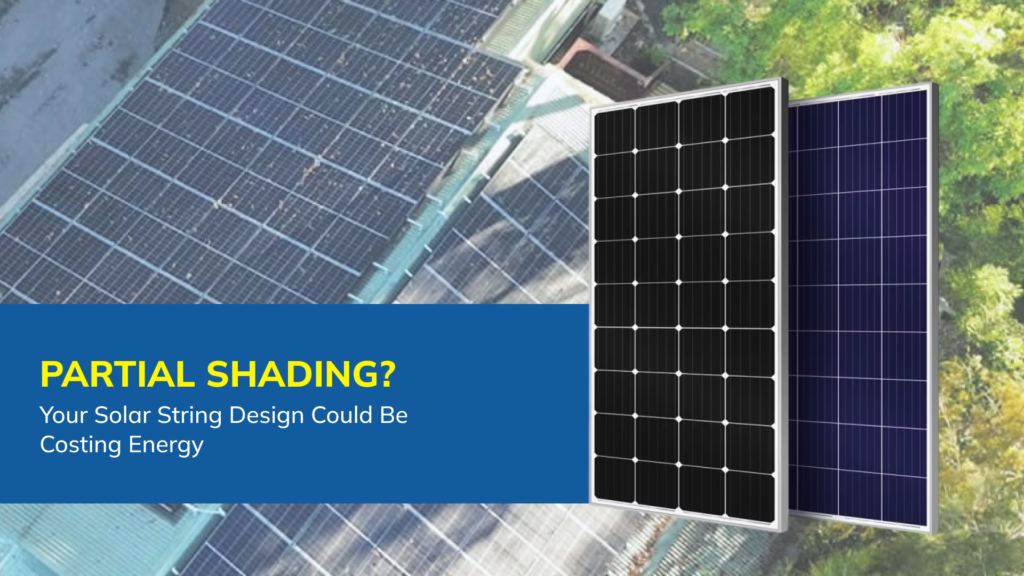
On-grid solar systems are the most common choice for homes going solar in Indore, largely because they are simpler and more affordable than hybrid or off-grid alternatives, as we explain in our comparison of on-grid, hybrid, and off-grid systems during power cuts. What many homeowners do not realise is that even a small amount of partial shading — from a neighbouring building, a tree, or a rooftop water tank — can meaningfully cut into an on-grid system’s output if the string configuration was not planned around it.
This article looks specifically at how shading interacts with string wiring in an on-grid setup, and the layout strategies that limit how much of your system’s output a small shaded area is allowed to affect. It is one of the core planning steps behind every solar panel installation in indore project we design, particularly for roofs that are not fully open and obstruction-free.
How On-Grid Solar Systems Work
An on-grid system generates DC power from the panels, converts it to AC through the inverter, and feeds it directly into your home’s electrical supply, with any surplus exported to the grid under net metering. There is no battery in between, which keeps the system simpler and more cost-effective, and is a major reason it remains the default choice across most residential solar panel installations, as detailed in our guide to net metering in Indore. Because there is no battery buffer to smooth out fluctuations, however, any loss in generation from shading shows up directly as a drop in real-time output.
What Happens When Shading Hits an On-Grid String
In a series-wired string, every panel must carry the same current, so when one panel in the string is shaded, its reduced current output caps the current for the entire string, not just the shaded panel itself. This means a single shaded panel out of, say, eight panels in a string can reduce that string’s output by far more than one-eighth, because the healthy, fully-lit panels are forced down to match the shaded one’s limited current — an effect worth understanding before finalising any solar panel installation in indore on a roof that is not fully open.
The Weakest Panel Problem
This effect is often called the weakest-panel problem, and it is the single biggest reason shading analysis needs to happen before a system is wired, not after. A shadow that only touches 10% of your total panel area on paper can realistically cost far more than 10% of your generation if the affected panels are spread across an otherwise strong string, which is one of the sizing and layout issues we flag in our article on mistakes homeowners make before installing rooftop solar.
String Configuration Strategies to Minimise Shading Loss
The most effective fix is planning string layout around the shading pattern before installation, not adjusting it afterward when options are limited. This is one of the technical planning steps we complete for every solar system installation near me enquiry we take on in and around Indore.
Splitting Strings by Roof Facet or Shading Zone
Grouping panels into separate strings based on which section of the roof they sit on — rather than simply wiring panels in the order they are physically laid out — means a shadow affecting one roof facet is contained to that facet’s string alone. This is especially relevant for L-shaped or multi-level roofs, a layout consideration that also affects how we calculate roof space requirements for different system sizes.
Using Module-Level Power Electronics Where Needed
For roofs with unavoidable, recurring shading, adding power optimisers or choosing a multi-MPPT inverter allows each panel or small group of panels to operate closer to its own individual capacity, rather than being tied to the output of the weakest panel in a long string. This is a targeted solution best reserved for roofs where shading genuinely cannot be avoided through layout alone, and it is a recommendation we only make after physically inspecting a roof for rooftop solar installation in indore, never as a default add-on.
The Case for a Site Survey Before Installation
Shading patterns shift through the day and across seasons as the sun’s angle changes, so a shadow that looks negligible at midday can be significant in the morning or evening. A proper site survey tracks these patterns before any string is finalised, which is why we treat this step as non-negotiable before recommending a system size, in the same way we assess consumption before answering how many kW of solar system a home actually needs.
How Solar World Energies Plans Layouts for Shaded Roofs
Our design process maps shading across the day using the physical roof survey, then groups strings and selects inverter MPPT configuration to contain any unavoidable shading rather than let it spread across the whole array. You can learn more about our design experience on our About Us page, or reach out through our Contact Us page to have your specific roof assessed.
This same shading-aware planning applies across our project sizes, from a single-facet home rooftop to a larger commercial solar panel installation spread across an industrial shed roof with multiple obstructions like ventilation units and skylights.
Conclusion
Partial shading does not have to mean a permanently underperforming solar system — the real damage usually comes from a string layout that lets a small shadow drag down panels that were never actually shaded. Before committing to a solar panel installation in indore quote, ask how the installer plans to group your strings around shading, and check our FAQ page for more on the technical checks worth confirming beforehand.
Frequently Asked Questions
Does a small amount of shading really affect an entire on-grid system?
Yes, because panels in a series string share current, a shaded panel can reduce the output of the whole string, not just its own individual output.
Can string configuration alone fix shading problems?
Good string layout significantly reduces shading losses, though roofs with severe or unavoidable shading may also need power optimisers or a multi-MPPT inverter.
Is on-grid solar still worth it if my roof has partial shading?
In most cases yes, especially with proper string planning, since even a partially shaded roof in Indore typically still gets strong overall sunlight through the day.
How do installers identify shading patterns before installation?
Through a physical site survey conducted at different times of day, sometimes supported by shading analysis tools, to map how shadows move across the roof.
Can I fix shading losses on an already-installed system?
Depending on the existing wiring and inverter, rewiring strings or adding power optimisers can help, though this is best confirmed with a technical assessment first.
Does partial shading affect on-grid systems differently than hybrid systems?
The string-level shading effect is similar across both, though hybrid systems have battery storage that can offset some of the real-time impact on daily usage.
Worried that shading from a nearby structure or tree could be limiting your rooftop’s output? Contact Solar World Energies for a shading assessment and a string layout designed around your actual roof.